October 24, 2026
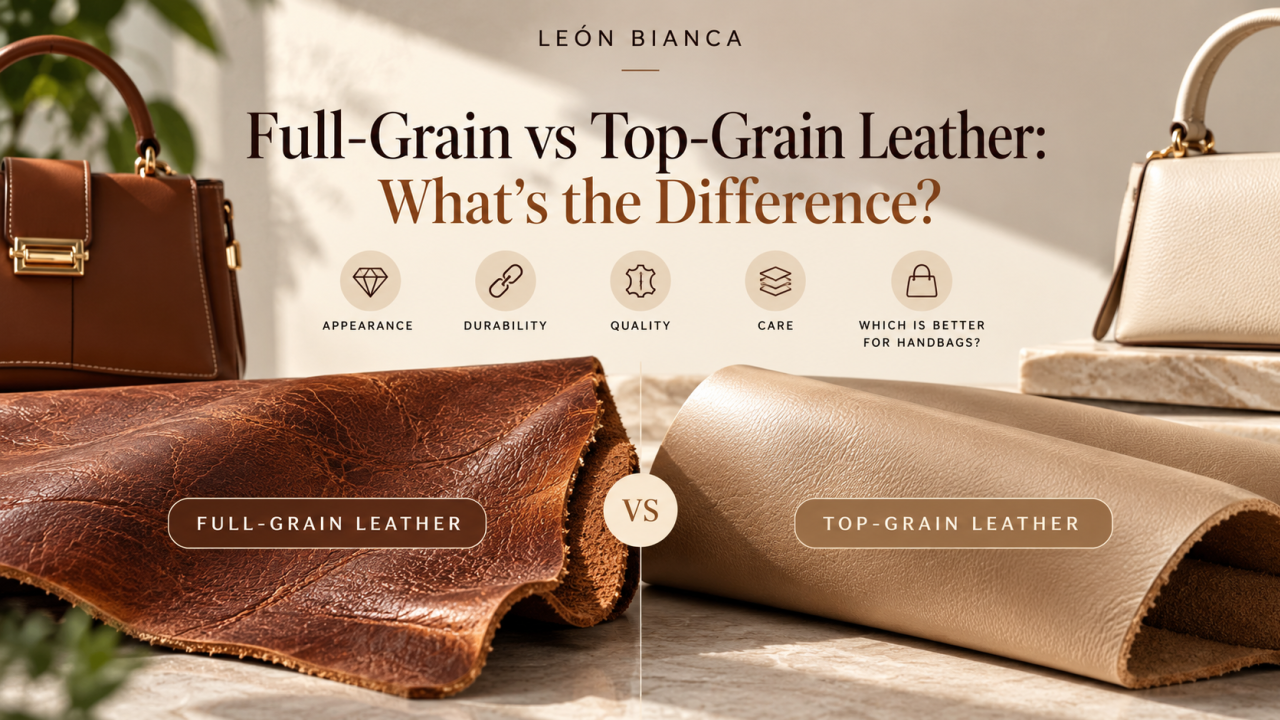
Full-Grain vs Top-Grain Leather: What's the Difference?
When shopping for a leather handbag, the material can make a significant difference to its appearance, feel and long-term performance. Two terms you will often encounter are full-grain leather and top-grain leather. Both refer to leather made from the outer part of an animal hide, but the way the surface is treated can influence how the finished material looks and ages.
So, what is the difference between full-grain and top-grain leather? Is one better than the other, and which should you choose for a handbag you plan to carry regularly?
The main distinction in common retail usage is the treatment of the natural grain. Full-grain leather retains its original grain surface, while top-grain leather is generally sanded or otherwise corrected to create a more uniform finish. Both can be used to make quality leather goods, but they offer different characteristics.
In this guide, we will explore the differences between full-grain and top-grain leather, compare their durability and appearance, and explain what to look for when choosing a leather handbag.
What Is Full-Grain Leather?
Full-grain leather is leather that retains its natural outer grain surface, without sanding or buffing away that surface to remove imperfections. After the hair and epidermis are removed during processing, the grain remains intact.
Because the natural surface is preserved, full-grain leather can show variations in texture, small marks and subtle differences in colour. These are natural characteristics of the hide rather than necessarily being defects.
Full-grain leather is often valued for its distinctive appearance and ability to develop a patina over time. Patina refers to the gradual changes in colour, sheen and character that can develop through exposure to light, handling, oils and everyday use.
Key characteristics of full-grain leather
1. Natural texture and character
Full-grain leather retains the original grain pattern, so no two pieces need to look exactly alike. The surface may contain natural markings that give each piece an individual appearance.
2. Potential for long-lasting use
The grain layer contains a dense network of fibres. When properly tanned, finished and constructed into a product, full-grain leather can be highly durable. However, the quality of the hide, stitching, construction and care all influence how long the finished handbag lasts.
3. A distinctive ageing process
Rather than maintaining exactly the same appearance throughout its life, some full-grain leathers develop a richer patina with use. The extent of this change depends on the leather's finish, colour and environment.
4. A naturally varied appearance
Full-grain leather may appeal to people who appreciate texture and subtle imperfections. If you prefer a perfectly uniform surface, however, its natural variations may not suit your taste.
5. Potentially higher cost
Full-grain leather can cost more because selecting suitable hides and preserving their natural grain may require more careful material selection. Actual prices depend on the tannery, finishing process, leather source and product construction.
For handbags, full-grain leather can be an appealing choice for those who appreciate natural texture and want a material that may develop character over time.
What Is Top-Grain Leather?
Top-grain leather generally refers, in commercial product descriptions, to leather from the outer grain layer that has been sanded, buffed or otherwise corrected to reduce visible imperfections and create a more consistent finish.
The precise terminology is not used identically by every manufacturer or technical standard, so it is worth checking how a brand describes its materials.
The surface treatment can make top-grain leather look smoother and more uniform than leather that retains its original grain. Depending on the finishing process, the material may also receive pigments, protective coatings or an embossed grain pattern.
Top-grain leather is still real leather. Its appearance and performance depend on the quality of the hide and the finishing methods used.
Key characteristics of top-grain leather
1. A more consistent surface
Surface correction can reduce the visibility of natural scars and markings. This can be useful when a handbag design calls for a clean, consistent appearance across multiple pieces.
2. A variety of finishes
Top-grain leather can be finished in different colours, textures and levels of sheen. Some finishes create a smooth, polished appearance, while others are designed to resemble a natural grain pattern.
3. Good performance when well made
Top-grain leather can be suitable for handbags intended for regular use. Its durability depends on the underlying hide, the degree of surface correction, the finish and the construction of the finished product.
4. A different ageing pattern
Because the surface may have been corrected or coated, top-grain leather may develop a different patina from untreated full-grain leather. Some finishes retain their original appearance well, while others may show wear, scratches or changes in the coating over time.
5. More options at different price points
Top-grain leather is available across a wide range of products and prices. Surface treatment alone does not determine whether a handbag is affordable, premium or luxurious.
For shoppers who prefer a refined, consistent appearance, top-grain leather can be a practical option.
Full-Grain vs Top-Grain Leather: Key Differences
The most useful way to understand the difference between full-grain and top-grain leather is to compare how each is processed and how those choices affect the finished material.
| Feature | Full-grain leather | Top-grain leather |
| Natural grain | Original grain surface retained | Surface commonly corrected or refinished |
| Appearance | Natural texture and possible markings | Often smoother and more uniform |
| Patina | Can develop distinctive character over time | Depends on the surface finish |
| Durability | Can be highly durable when well made | Can also be highly durable when well made |
| Surface consistency | Natural variations are more visible | More consistent appearance is possible |
| Maintenance | Depends on the finish and leather type | Depends on the finish and leather type |
| Price | Can be more expensive | Available across a wide range of prices |
| Best suited to | Those who appreciate natural character | Those who prefer a more uniform finish |
The distinction is not simply that one leather is good and the other is bad. It is about the material's surface, the finish you prefer and the performance you expect from the finished product.
A well-constructed top-grain leather handbag can be a better purchase than a poorly made full-grain bag. Material grade matters, but it is only one part of overall quality.
Which Leather Is More Durable?
Full-grain leather is often associated with durability because it retains its natural grain surface. However, it would be misleading to say that every full-grain leather product will necessarily outlast every top-grain leather product.
Durability depends on several factors, including the hide's quality, tanning, finishing, thickness, stitching, construction and the way the handbag is used.
Full-grain leather durability
Full-grain leather can be a strong choice for products intended for long-term use. Its natural grain remains intact, and suitable finishes can allow it to develop a distinctive appearance as it ages.
However, natural grain does not make leather immune to scratches, stains, moisture or colour changes. Some finishes also require more careful maintenance than others.
Top-grain leather durability
Top-grain leather can also offer good durability. Its performance depends on how much the surface has been corrected and which finishing treatments have been applied.
Certain finishes can provide useful resistance to everyday marks and make routine cleaning easier. Others may be more susceptible to visible scratching, cracking or wear if the coating deteriorates.
Which should you choose for everyday use?
If you enjoy natural texture and the way leather can change with age, full-grain leather may suit you.
If you prefer a consistent surface and a particular polished finish, top-grain leather may be a better fit.
For either option, look beyond the label. Examine the stitching, handle attachment points, edges, lining, closures and overall construction. These details can have a substantial impact on how a handbag performs with regular use.
Full-Grain vs Top-Grain vs Genuine Leather
When researching leather handbags, you may also encounter the term genuine leather. The phrase can be confusing because it sounds like a quality grade, but it primarily indicates that the material is leather rather than an imitation. It does not, by itself, establish the leather's quality.
In some commercial contexts, genuine leather is used to describe lower-grade leather or products made from split leather. However, the phrase is not a sufficiently precise description to determine the material's exact composition or quality.
Here is how the three terms are commonly understood in retail settings.
Full-grain leather
Full-grain leather retains its original grain surface. It is often chosen for its natural texture and potential to develop a patina over time.
Top-grain leather
Top-grain leather generally refers to outer-grain leather whose surface has been corrected or refinished. It can have a more uniform appearance while still offering good performance.
Genuine leather
Genuine leather is a broad term that confirms the material is leather but does not provide enough detail to determine its grade, finish or durability. It can refer to different types of leather, so the manufacturer's material description is important.
When comparing products, do not rely on the word genuine alone. Look for a clear description of the material, the type of finish and the construction of the handbag.
How to Identify Full-Grain Leather
Identifying full-grain leather can be challenging because modern finishing techniques can make different leather types look similar. A smooth surface does not automatically indicate top-grain leather, and visible texture does not prove that a product is full-grain.
If you are evaluating a leather handbag, the following checks can help you make a more informed decision.
1. Check the product description
Start with the manufacturer's material specifications. A reliable product description should explain the leather used rather than relying only on broad terms such as premium leather or genuine leather.
If the description is unclear, ask the seller to confirm the exact material and finish.
2. Look at the natural grain
Full-grain leather generally retains more of the hide's original surface character. You may notice subtle variations in texture, pores or natural markings.
However, these features are not conclusive on their own. Embossed and corrected leathers can also have convincing grain patterns.
3. Examine the edges and construction
Look at the edges, seams, handles and areas where the material has been cut or folded. These details can provide clues about the product's construction, but they cannot reliably establish the leather grade without additional information.
Well-finished edges and neat stitching are signs of careful workmanship, not proof of full-grain leather.
4. Ask about the finish
Leather can be dyed, pigmented, coated or embossed. These processes affect how the material looks and behaves.
Ask whether the leather has a natural, corrected, pigmented or otherwise treated finish. This information can be more useful than trying to identify the grade from photographs alone.
5. Avoid unreliable home tests
Burning, scratching, soaking or applying harsh chemicals to a handbag is not a reliable way to establish its leather grade. Such tests can damage the material and may produce misleading results.
When the distinction matters, a clear manufacturer specification or an assessment by a qualified leather professional is a better approach.
Which Leather Is Best for Handbags?
The best leather for a handbag depends on how you plan to use it, the appearance you prefer and the level of maintenance you are comfortable with.
Rather than choosing based on a grade name alone, consider the features that matter most to your lifestyle.
For everyday handbags
If you carry your bag frequently, focus on construction, comfortable handles, secure closures and a finish that suits your routine. Both full-grain and top-grain leather can work well, provided the material and construction are appropriate.
For a natural, distinctive look
Full-grain leather may appeal to you if you enjoy natural texture and gradual changes in appearance. Its character can evolve with regular use, depending on the finish and care.
For a smooth, refined appearance
Top-grain leather may suit shoppers who prefer a consistent surface and a more uniform finish. The range of available treatments makes it adaptable to different handbag designs.
For a premium investment
If you are choosing a handbag you hope to use for years, examine the entire product rather than paying more for a leather label alone.
Consider the quality of the leather, stitching, hardware, lining, handle construction and finishing. Also check the brand's care instructions and any applicable product warranty.
Ultimately, the best handbag is one that balances material quality, design, practicality and personal style.
Explore the LEÓN BIANCA handbag collections to find a style that suits your wardrobe and everyday needs.
Frequently Asked Questions
1. Is full-grain leather better than top-grain leather?
Full-grain leather is often preferred by people who value natural grain and the potential for a distinctive patina. Top-grain leather can be a good alternative for those who prefer a more uniform surface. Neither label alone guarantees the quality of the finished product.
2. What is the main difference between full-grain and top-grain leather?
In common retail terminology, full-grain leather retains its original grain surface, while top-grain leather is generally sanded, buffed or otherwise corrected to create a more uniform appearance.
3. Is top-grain leather real leather?
Yes. Top-grain leather is real leather. The term generally describes leather from the outer grain layer that has undergone surface correction or finishing.
4. Does full-grain leather last longer?
Full-grain leather can be highly durable, but the lifespan of a leather product also depends on tanning, finishing, construction, use and care. A well-made top-grain leather handbag can also last for many years.
5. What is the difference between full-grain and genuine leather?
Full-grain leather describes leather that retains its original grain surface. Genuine leather is a broader term that does not specify the exact grade or finishing process. Always review the product's material details before comparing quality.
6. Is full-grain leather worth the extra cost?
It may be worth the additional cost if you appreciate natural texture, want a leather that can develop a patina and value the particular characteristics of full-grain material. Your decision should also account for construction, design, maintenance and budget.
7. How can I tell if a handbag is made from full-grain leather?
Check the manufacturer's material specifications first. Natural texture and markings can offer clues, but visual inspection alone is not definitive because corrected and embossed leather can resemble natural grain.
8. How should I care for a leather handbag?
Follow the manufacturer's care instructions for the specific leather and finish. In general, avoid prolonged exposure to moisture and direct sunlight, wipe away surface dirt with a soft cloth, and use only suitable leather-care products. Test any product on a discreet area first.
Final Thoughts
Understanding full-grain vs top-grain leather makes it easier to compare leather handbags beyond their appearance and price. Full-grain leather preserves the natural grain and can develop a distinctive patina, while top-grain leather is commonly finished for a smoother, more consistent look.
Both can be suitable choices for a well-made handbag. The right option comes down to the finish you prefer, how you intend to use your bag and the quality of the complete product.
When shopping for a leather handbag, look for clear material descriptions, thoughtful construction and a design that fits your lifestyle. These details will help you make a more confident choice.